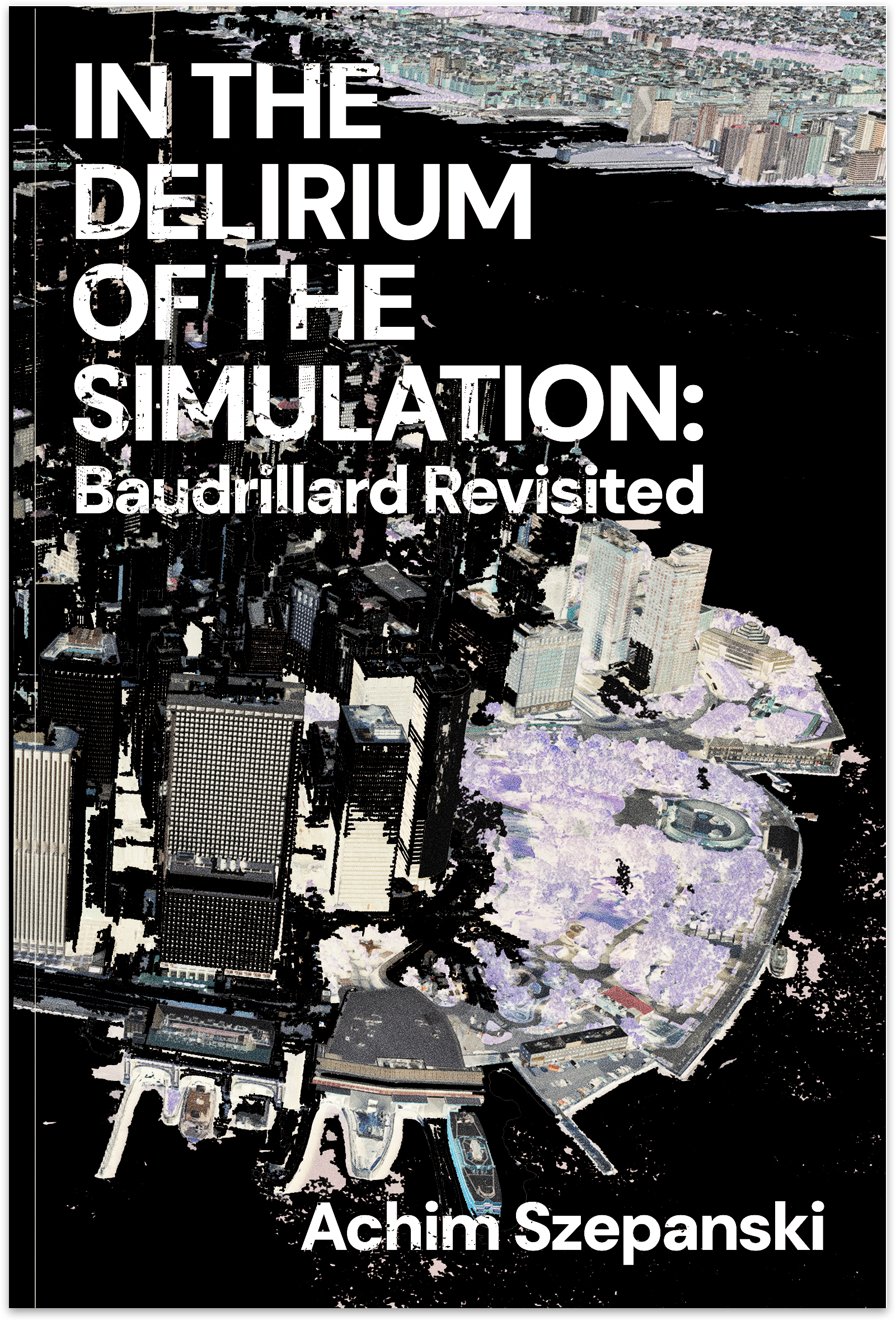
taken from the book: In the Delirium of Simulation. Baudrillard revisited
Rex Butler places Baudrillard’s concepts of simulation and seduction in a close context. (Butler, 1999: 71ff.) To understand seduction as a doubling of simulation would mean that, due to its vagueness, it can never be seen as such, but can only ever be represented in a simulated form. If seduction can only ever be seen in a simulated form, then this is due to seduction itself. For this reason, Baudrillard can say that seduction is inextricable and inescapable, even an essential form of the world. In a certain sense, seduction and simulation always propose a relationship to an Other, but simulation ultimately always attempts to name this Other in order to control the boundary, whereas seduction does not even know this boundary, because for it the Other is constitutive precisely in its vagueness. This is why seduction is neither identical with simulation nor completely opposed to it, but “doubles” it in a perverse way, making simulation possible and impossible at the same time. If the simulation goes too far and tries to overcome the distance between copy and original, it implodes, while seduction is both the distance that makes the similarity possible and at the same time the distance that arises when the similarity is too great. Seduction includes the necessary distance between things, which in turn invokes the endless efforts of simulation to overcome it, but it is seduction that ultimately shows that simulation never fully succeeds in doing so (Ibid.). Seduction is ambiguous and reversible: it is both that which enables simulation and therefore allies itself with it, as well as that which attempts to abolish simulation and is therefore also potentially subversive to it. Seduction is no longer an affirmative concept of symbolic exchange, which supposedly exists outside the current system and has perhaps been lost and could be regained by transgression.
Seduction, as Baudrillard conceives it on a general level, can enter into an alliance with the general economy envisaged by Derrida or Bataille, which stands in opposition to the “restricted” economy. It is that part of the surplus or surplus that remains obsessed with the idea that everything arises only in the duel of the one with the other, that the basic rule of the world is thus that of a never-ending reversibility[i].
Seduction plays with the fragility of appearances; it has no model and seeks no form of redemption—it is therefore immoral and does not obey any morality of exchange, rather it is based on the pact, the challenge and the duel, which are not universal or natural, but artificial and initiatory forms (Baudrillard, 1991: 122). The duel relationship, which implies seduction, thus definitively abolishes the law of exchange. With Levi Strauss, Baudrillard assumes in his book The Symbolic Exchange and Death that there are two main types of social systems, namely that of the reversible symbolic exchange of earlier societies and the asymmetrical contemporary system of subordination, which is one-sided, irreversible and based on command structures, although Baudrillard accentuates this one-sidedness quite differently from Levi Strauss. Although seduction retains the moment of reversibility, in contrast to exchange it is characterised by an asymmetry that does not, however, lead to the subordination of one part to the other. The rules of perversion also suspend the natural law of sex. As with play, the content is of little importance here and the imposition of a rule or a system of signs remains essential. In seduction, desire and affects are played with in a perverse way, and it does not aim at any kind of drive discharge as in sex or a final event or fusion as at least in the romantic ideal of love. According to Baudrillard, what is decisive for man is not desire or wish, but rather the illusion in which seduction always remains embedded (Baudrillard, 2012a). It is not necessary to decipher, but rather to delusionally pursue illusions. Transform the clear into a riddle. Making incomprehensible what is far too comprehensible.
For Baudrillard, seduction initially generally involves a mutual concatenation of forms, thus, because limitation is inherent in form, seduction correlates with the solid crystal state in contrast to the ecstasy and boundlessness of love. This concatenation of forms or elements is to be understood neither as necessary nor as coincidental, neither as teleological nor as aimless; an encounter or concatenation simply takes place or not. Moreover, seduction merely connects the forms on the surface, whereas (romantic) love seeks to unite substances in depth. However, we must also bear in mind that love remains an ideal, and the less it is realised today, the more it lives on in simulacra, including the infidelities that often enough add spice to marriage. Like love, seduction never pushes for a mystical fusion, but pays homage to the malleable duel, which is not simply based on oppositeness, but on otherness with simultaneous complicity, thus remaining an altogether strange duel that relies on reciprocity and mutuality in otherness. Seduction initially derives its intensity from the formal and duel-like separation, but it forces both the affirmation and the abolition of the other in the duel, whereby the latter corresponds to a union that does not strive for a fusion, but merely confirms the reciprocity. According to Baudrillard, seduction always manifests itself in a simultaneous opposition: either it unites the divided things or it divides the undivided things (Ibid.).
Röttgers also brought seduction into play against the ideal of love, whereby the latter is not a strategy for him, but is also based on unpredictable concatenations, which in turn presuppose reciprocity. In contrast to love, it knows no jealousy or exclusivity. Seduction is based on entanglement, insofar as seduction and being seduced are complementary: While the seduced person definitely sees the being-seen, the seeing of the being-seen is in turn seen by the seducer (Röttgers, 2021: 152). Thus the seducer is also the seduced and the seduced becomes the seducer. We seduce only insofar as we risk being seduced and insofar as we cannot know whether we are seducing or being seduced. This undecidability arises, without which it would be impossible to determine whether it is I who seduces the other or the other who seduces me. It is an endless undecided refrain. There is no active or passive mode in seduction, no subject or object, no inside or outside: seduction plays on both sides, and there is no boundary that separates them. You cannot seduce others if you have not been seduced yourself. The illusion that leads from one to the other is subtle. Since seduction never stops at or seeks the truth, but operates through deception and secrecy, it opens up a mode of circulation that is itself secretive and ritualistic, a kind of immediate initiation that plays by its own rules (Baudrillard, 2012a: 90ff.).
To be seduced therefore means, on the one hand, to be turned away from one’s own truth and, on the other, to lead the other away from their truth. Seduction induces one to die as a true reality and to restore oneself as an illusion, even to be caught up in one’s own illusion and to move in an enchanted world. The truth then becomes a secret that escapes him/her. Seduction is also immediately reversible, and its reversibility is constituted by the challenge it implies and the mystery in which it absorbs the truth. Here, however, as Röttgers suggests, a medial event can also open up in between or within the framework of a delayed approach, which knows closeness and distance and thus the difference and thus also allows for the figure of the third party who intervenes in the game of the seducer and the seduced (Röttgers, 2021: 152). Baudrillard also ignores the third party in the game of seduction, who can appear here as a competitor, rival or excluded party (Fischer, 2022: 114). For Röttgers, in contrast to Fischer, the third party is not an independent personal position that merely overcomes the theorem of intersubjectivity. In the communicative text, the self, the other and the third party can change through intervention. Baudrillard does not consider the third party or third parties because asymmetry and alterity are only possible for him in duality, which does not correspond to the dialectic of the one and the other, but is an antagonistic principle. Only in duality can an asymmetry arise for him, male and female, which in turn is based on mutual attraction. For Baudrillard, the third or multiplicities (system), but also the third or multiplicities, are to be understood merely as mirror games of difference.
In any case, seduction never remains in the space of the visible; in other words, seduction leads into the approximate of a gaze, and indeed also into the abyss (as a third moment). For Heidegger, the abyss is the hole in which being can be located as an event. From this, Röttgers concludes sharply that seduction is the place where being as event takes place (ibid.: 158). The view into the abyss does not demonstrate a deep structure of reality, but only allows another surface to appear in a flash. The abyss takes place between closeness and distance—two people touch each other, but allow themselves to enter into a distance that a third person may take, which here is an abyss. For Röttgers, the distance is a third element as the founding abyss. For Baudrillard, on the other hand, seduction is always the game between two, the duel. However, the abyss at least makes visible a contingent eventfulness that breaks through continuity and normality and can, but does not have to, act as an abysmal seduction. In other words, very different things can emerge here or not. For Röttgers, this also opens up a potential space of power that has the modal structure of an invisible field. Hyperreality, on the other hand, in which seduction has no place, overstretches the visible and produces obscenity, which stands for maximum visibility. More visible than the visible, that is, obscenity. In contrast, the abyss preserves the secret, which in turn is more invisible than the invisible. Seduction is about the abysmal play of visibility and invisibility that can produce the visible and the invisible, whereby there is no instance that produces the abyss positively as mystery or negatively as obscenity (Ibid.: 153).
As Röttgers correctly notes, Baudrillard’s non-strategy of seduction, which is always to be understood as a challenge, is the last objection to the now toxically circulating theory of recognition and intersubjectivity (Honneth, Jaeggi etc.). The reciprocity of seduction is never democratic and never ends in agreement, rather it is alternately asymmetrical (seducer and seduced constantly change unequal positions) (Ibid.: 148). While the theory of intersubjectivity literally eradicates alterity, seduction relies on the alterity of the incomparable in order to escape the growth progression of the same through the same. Alterity can also be understood as a radical heterarchy, namely as a poly-textural non-system that manages without highest levels and hierarchies and interweaves neuronally under the rule of the many. On the other hand, the connection of two equals, which is still sold by the left as solidarity, is obscene. Baudrillard underpins his hypothesis of seduction, which always remains uncertain, with the help of Heisenberg’s indeterminacy relation. Real interaction only exists at a distance.
While the productive, according to Baudrillard, strives to create unambiguity and identification and the interchangeable exchange is characterised by the comparison of identities, seduction presents itself as a non-productive form of ambivalence that expresses the vicissitude of a duel form that takes place in seduction, albeit an incomparable vicissitude. In the ritual of seduction, however, the fundamental distance is maintained and space is given to the metamorphoses so that the forms can be illuminated by their opposing energies. In contrast, today we are confronted with a great closeness of things and flat obscenity, which Baudrillard resolutely rejects.
The ambivalence or the seductive and alluring duality thus calls into question the legitimacy of values and comparability. Baudrillard pointedly calls seduction that which “snatches the same from the same” (Baudrillard, 1992: 61). Seduction is a challenge in which each takes the other into a mutual obligation to respond: the relationship, if this is the right word, is dual/dual. It is at the same time an art of disappearance, not in the sense of a dissolution of opposites, but in the sense of a movement or transformation from one pole of reciprocity to the other, a game that pays homage to strangeness, the game that simultaneously enters into reciprocity but does not result in reconciliation. For Baudrillard, it is important to uncover the fundamental ambivalence that constitutes the game of reversibility in the first place. Reversibility marks a process in which things are to be understood as inherently ambivalent in the course of an inseparability of what something is from what it is not. This is neither the order of identity (A/non-A), nor the order of a death drive or immersion in undifferentiated chaos. The symbolic inversion is ambivalent, whereby each meaning is never singular and positive, rather what is contains the possibility of its seduction and its transformation. However, and Baudrillard forgets this, the third party can intervene in the duel as a mediator or intriguer.
For Baudrillard, it is ultimately the incomparable power of femininity, which in its alterity takes itself for its own desire and delights in the self-deception with which men, for their part, are captured. The feminine stands for the ritual of seduction, whereby for Baudrillard it is terrible to want to desacralise woman as a cult object in order to transform her into a subject of sexual production, or to want to rescue her from artificiality in order to let her find her way back to her own “natural” desire (Baudrillard, 2012a). When the body becomes nature, sexuality is functionalised and transformed into an element of the economy of the subject. To the extent that the body is simultaneously signified or represented, sexuality is individualised as a function of the subject: sexuality becomes a function of the expression of subjectivity, it becomes a function of personal equilibrium, mental health and a function of unconscious emanations. This model generates the opposition male/female, which takes the phallic organ as a point of reference and closes the play of signifiers of the body. For Baudrillard, on the other hand, the feminine is a force of seduction that subverts the masculine as a force of production. The feminine is not a gender in the sense of a gender that is opposed to the other gender, but rather that which is generally opposed to the gender that has codified itself as gender. Femininity shakes up the sexual poles, it is that which destroys or at least seduces the differential opposition (Grace, 2000).
In seduction, it is important to consider the difference between ambiguity and ambivalence, which can be defined as follows: differential of value vs. duel of form, alterity; indeterminacy vs. gender uncertainty; dialectics vs. non-classical but dualistic logic. In contrast to alterity, the concept of difference, which Baudrillard rejects, is based on comparability, in which the differences are inscribed (signs or consumers are placed in difference to other signs and consumers); it means a trivialisation of the duel, because in the final instance it boils down to a common denominator, for example money, which makes the comparison of qualitatively different things possible in the first place. Baudrillard’s ambivalence has many names and can also be captured, for example, with the pairing “duel/dual” (Ibid.: 97ff.). The duel denotes fundamentally agonistic social relations, a sociology of challenge, beginning with the kula and the potlatch, while the dual, on the other hand, stands for a logical trope identical to the logic of the double and mirroring. Although seemingly unrelated, the two forms are deliberately mixed in Baudrillard’s thinking. As doubling expands with reproduction and then escalates with information processing, a logic of challenge always develops between the thing and its copy (the more x than x). The duel/dual also illuminates the intersection between Baudrillard’s theories of social relations and representation. If representation is also based on the principle of identity, this does not automatically mean that there is always a correspondence (or equivalence), because duplications can also lead to new challenges and ambivalences
[i] In this context, Baudrillard presents three forms of relation that can be defined both historically and logically: First, the relation of play or ritual located in the sphere of the rule; second, the polar, dialectical, antithetical relation of the social and the meaning located in the sphere of the law; third, the digital connection of norms and models located outside the forms of relation. According to Baudrillard, the last relation results in a growth progression of the same, which means that alterity finally falls by the wayside at this stage.
you can order here: https://forceincmilleplateaux.bandcamp.com/merch/in-the-delirium-of-the-simulation-baudrillard-revisited-by-achim-szepanski